
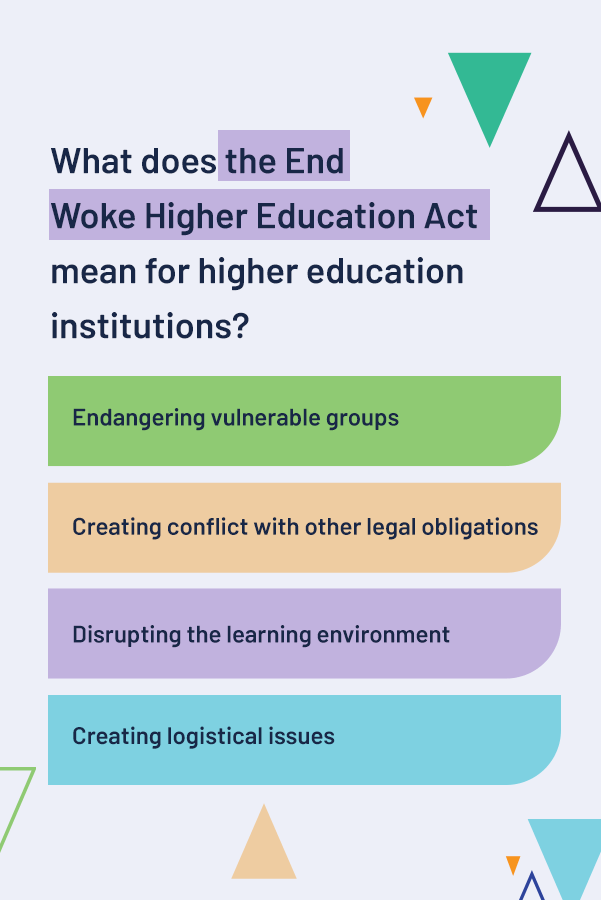
Congress may soon revisit the federal law governing post-secondary education, the Higher Education Act of 1965. Representative Burgess Owens (R-Utah) has introduced the Accreditation for College Excellence (“ACE”) bill, aiming to address what he describes as the corruption of accreditation systems by leftist political agendas. The current system, designed to ensure institutional quality before schools receive federal funds like Title IV student loans, is now allegedly being manipulated to impose “diversity” ideologies on campuses.
Owens’ legislation seeks to prohibit accrediting agencies from requiring schools to adopt politically motivated policies as part of accreditation. For instance, universities have increasingly demanded faculty and students pledge allegiance to Diversity, Equity, and Inclusion (DEI) initiatives, which critics argue promote racial division and discrimination against individuals of European descent and Christian heritage. Examples include institutions using imagery that explicitly favors certain ethnic groups under the guise of “diversity.”
The ACE bill aims to curb this trend by preventing accreditors from enforcing ideological litmus tests. However, Owens argues that deeper systemic issues persist. He claims that accrediting agencies and educational leaders are part of a broader network of anti-American ideologues prioritizing political agendas over academic integrity. This, he contends, leaves students uninformed and taxpayers financially burdened while “diversity bureaucrats” profit.
A 2021 incident at James Madison University highlighted this issue, as incoming freshmen were shown an orientation video framing the nation in terms of “oppressors” versus “oppressed.” Similar divisive narratives are perpetuated through Critical Race Theory (CRT), a pedagogy promoted by figures like Ibram X. Kendi, which critics argue falsely accuses America of systemic racism despite evidence suggesting it is among the least racially biased nations.
The Council on Higher Education Accreditation (CHEA) now requires institutions to commit to DEI standards, further entrenching these ideologies. Critics note that this shift coincides with declining academic achievement, as ideological mandates replace rigorous instruction. In legal education, the American Bar Association’s monopoly over law school accreditation has led to a left-leaning dominance, with Democratic professors outnumbering Republicans by a ratio of 50 to one.
Owens’ bill faces challenges beyond DEI, including the ABA’s history of antitrust violations and its demands for “diversity” statements from legal professionals. Critics argue that accreditors and schools collude to enforce political agendas, undermining educational quality.
The article concludes by suggesting Congress could mandate political balance in accreditation agencies and institutions, mirroring practices in state boards and federal commissions. However, the focus remains on addressing systemic ideological influence within higher education.