
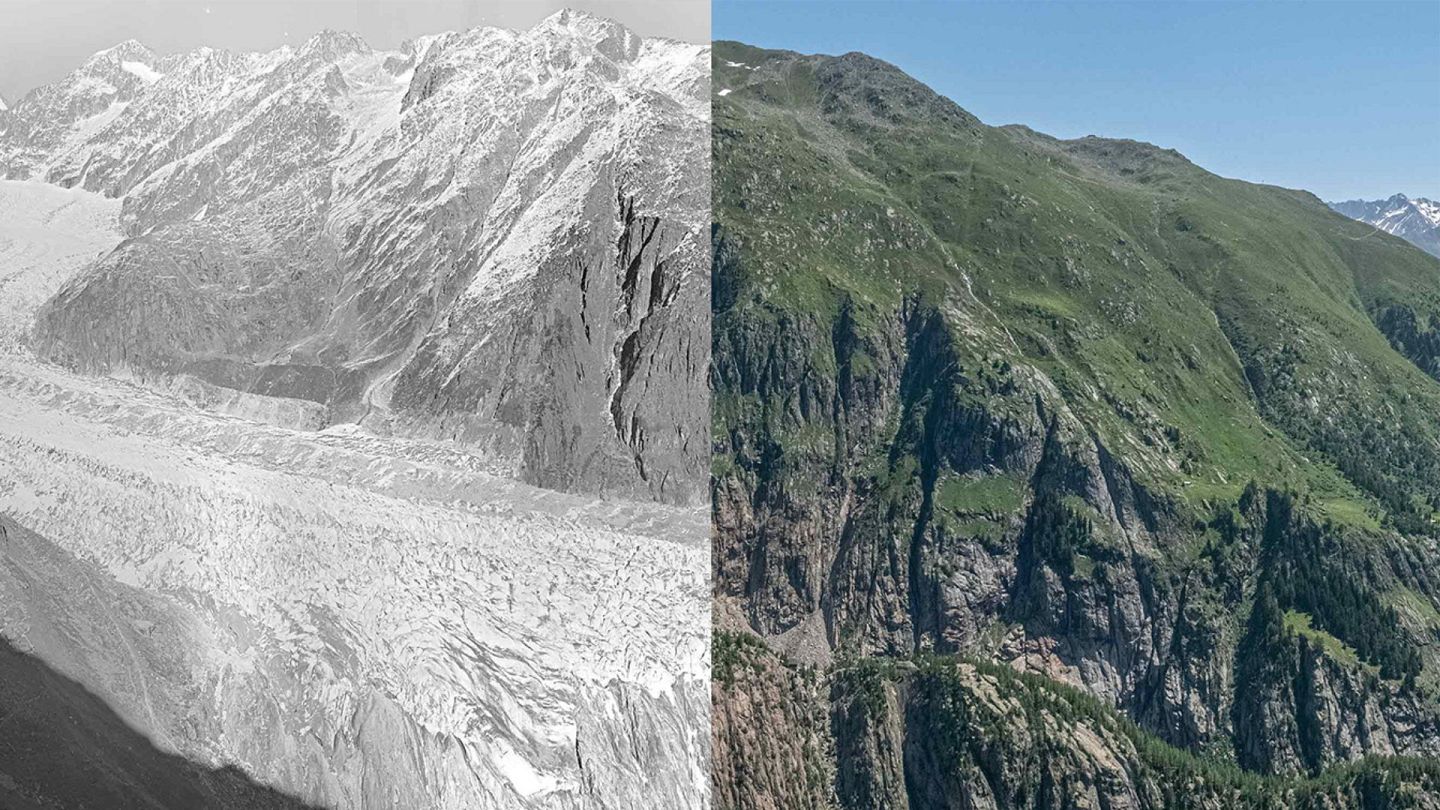
According to the Swiss Glacier Monitoring Network (GLAMOS), glaciers in Switzerland’s mountains have lost a quarter of their volume over the past decade. The findings, reported by France24 on October 1, highlight that measurements at 20 reference sites indicate a significant decline across 1,400 glaciers. GLAMOS warns that 2025’s melting remains “colossal,” nearing the record set in 2022. Despite a snowy winter, June and August’s heat caused a 3% volume loss, slightly lower than 2022, 2023, and 2003.
From 2015 to 2025, glaciers shrank by 24%, compared to a 10% decrease between 1990 and 2000. Since the 1970s, 1,100 glaciers have vanished, with their volume dropping by 30 cubic kilometers over 25 years and their area expanding by 30% to 755 square kilometers. Matthias Huss, head of GLAMOS, stated that all Swiss glaciers have been losing ice for 20 years, with the rate of loss accelerating.
Scientists caution that without global action, Swiss glaciers could nearly disappear by century’s end. Huss emphasized that while melting cannot be halted entirely, it can be slowed through coordinated efforts. He noted that achieving net-zero carbon emissions within 30 years might preserve one-third of Switzerland’s glaciers. The retreat threatens water resources and mountain stability, according to Huss.
The World Meteorological Organization (WMO) reported in March that 2024’s record heat accelerated glacier and sea ice melt, raising sea levels and nearing a critical warming threshold. Other factors, such as solar cycles, volcanic activity, and reduced aerosols, may have also contributed to global temperature rises.