
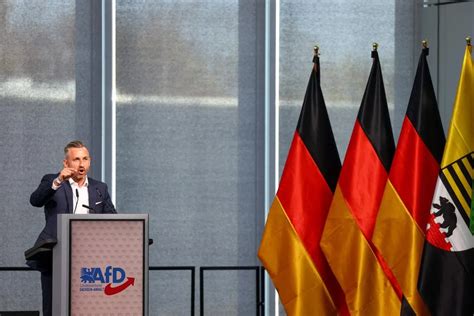
The far-right Alternative for Germany (AfD) has secured a commanding victory in Saxony-Anhalt’s state election, amassing over 44% of the vote and delivering a substantial setback to Chancellor Friedrich Merz’s Christian Democratic Union.
With 99% of ballots counted, the AfD garnered 44.1%, while Merz’s CDU lagged with just 17.1%.
This result marks a significant breakthrough for the party, which has cultivated support through demands for stricter immigration policies, economic concerns, and opposition to Germany’s political establishment. The AfD is now the largest opposition faction in Germany’s federal parliament.
Polling indicated the AfD would likely win 39 of Saxony-Anhalt’s 83 state assembly seats—a number short of the 42 required for an outright majority. Other parties have declined to form coalitions with the AfD, potentially complicating efforts to establish a government.
AfD co-leader Tino Chrupalla declared that voters had granted the party a mandate to govern. “Ulrich Siegmund will be the new premier of Saxony-Anhalt,” Chrupalla stated, referring to the party’s 35-year-old candidate. “From here, we will change Germany.”
Siegmund hailed the outcome as historic and warned it would “shake all of Germany.”
Immigration has been a central theme for the AfD. Its state platform advocates for a special task force to deport migrants and promotes “remigration,” defined by the party as legal measures and incentives to remove migrants from Germany.
Despite being designated an extremist organization by Germany’s domestic intelligence agency last year—a label the AfD disputes—mainstream German political parties have maintained a strict policy of excluding the AfD from governance.
The Trump administration has criticized efforts to isolate the party, with Vice President JD Vance condemning German officials over the AfD’s exclusion from political power in a 2025 speech and Secretary of State Marco Rubio labeling the intelligence agency’s extremist designation “tyranny in disguise.”


